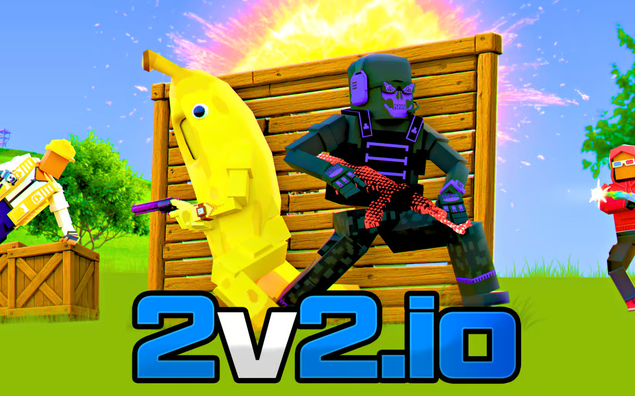
It’s funny how quickly online games expose your bad habits. You tell yourself you’re a careful player, someone who always thinks before acting. Then you load into a match of 2v2.io, charge straight toward the nearest opponent, and discover that your brilliant plan lasted about six seconds.
That’s the beauty of the game.
At first glance, 2v2.io looks familiar. It’s a browser-based multiplayer shooter with quick matches, simple controls, and instant action. You jump in, move around the map, and try to outplay the opposing team. Nothing sounds especially unusual, and that’s probably why so many new players underestimate it.
The real challenge isn’t shooting.
It’s learning how to play with another person.
Unlike free-for-all games where everyone is responsible only for themselves, 2v2.io constantly reminds you that every decision affects your teammate as well. Push too aggressively, and you might leave them alone against two opponents. Stay too far back, and they’ll wonder where their support disappeared. Finding the balance becomes part of the game, and surprisingly, it’s one of the most enjoyable parts.
The controls are refreshingly simple. Movement feels natural, aiming is responsive, and there’s almost no learning curve when it comes to basic gameplay. Within a couple of minutes, even someone completely new to browser games can understand how everything works.
Understanding how to win takes a little longer.
One thing that impressed me after several matches was how often teamwork beat individual skill. Every now and then you’ll meet someone with incredible reflexes who can pull off spectacular plays, but those players aren’t unbeatable. Two teammates working together usually create far bigger problems than one talented player trying to carry an entire match alone.
That idea shapes every battle.
You’ll start noticing small details that seemed unimportant at first. Waiting two extra seconds before attacking because your partner is still catching up. Moving sideways instead of forward to create a better angle. Choosing not to chase an enemy because separating from your teammate would create a bigger risk than the potential reward.
Those aren’t dramatic decisions, yet they win games.
The pace deserves some credit as well. Matches never drag on. Whether you win or lose, another opportunity arrives quickly. That rhythm makes it easy to play a few rounds without feeling trapped in a long commitment.
Of course, saying “just one more match” is a dangerous habit.
The visual presentation follows the same philosophy as the gameplay. Everything important is immediately visible, allowing players to focus on positioning and movement instead of trying to understand what’s happening on the screen. It proves that clarity can sometimes be more valuable than flashy graphics.
For beginners, my biggest recommendation would be to stay patient. Many players believe speed automatically creates success. In reality, rushing into every encounter usually creates opportunities for the other team instead.
Watch how experienced duos move.
They rarely separate without a reason. One player applies pressure while the other covers a different angle. They retreat together, attack together, and constantly make life difficult for anyone trying to fight them alone.
Communication naturally becomes another important skill. Even if you’re playing without voice chat, paying attention to your teammate’s movement tells you a surprising amount. A short pause, a change of direction, or a cautious approach often communicates exactly what’s about to happen.
Then there are the unforgettable moments.
Those rounds where everything falls into place. Every shot connects, every decision works, and your team somehow predicts every move the opponents make. You finish the match convinced you’ve finally mastered the game.
The next round usually reminds you that there’s still plenty to learn.
That’s part of what keeps 2v2.io interesting. Every match feels slightly different because every teammate and every opponent approaches the battlefield in their own way. Some play aggressively from the first second, while others patiently wait for mistakes. Adapting to those different styles becomes an enjoyable challenge instead of a frustrating obstacle.
In the end, 2v2.io succeeds because it focuses on something surprisingly simple. It isn’t trying to overwhelm players with complicated systems or endless upgrades. Instead, it asks one straightforward question.
Can two players work together better than the other two?
Most of the time, the answer has very little to do with who has the fastest mouse.
It has everything to do with who trusts their teammate the most.